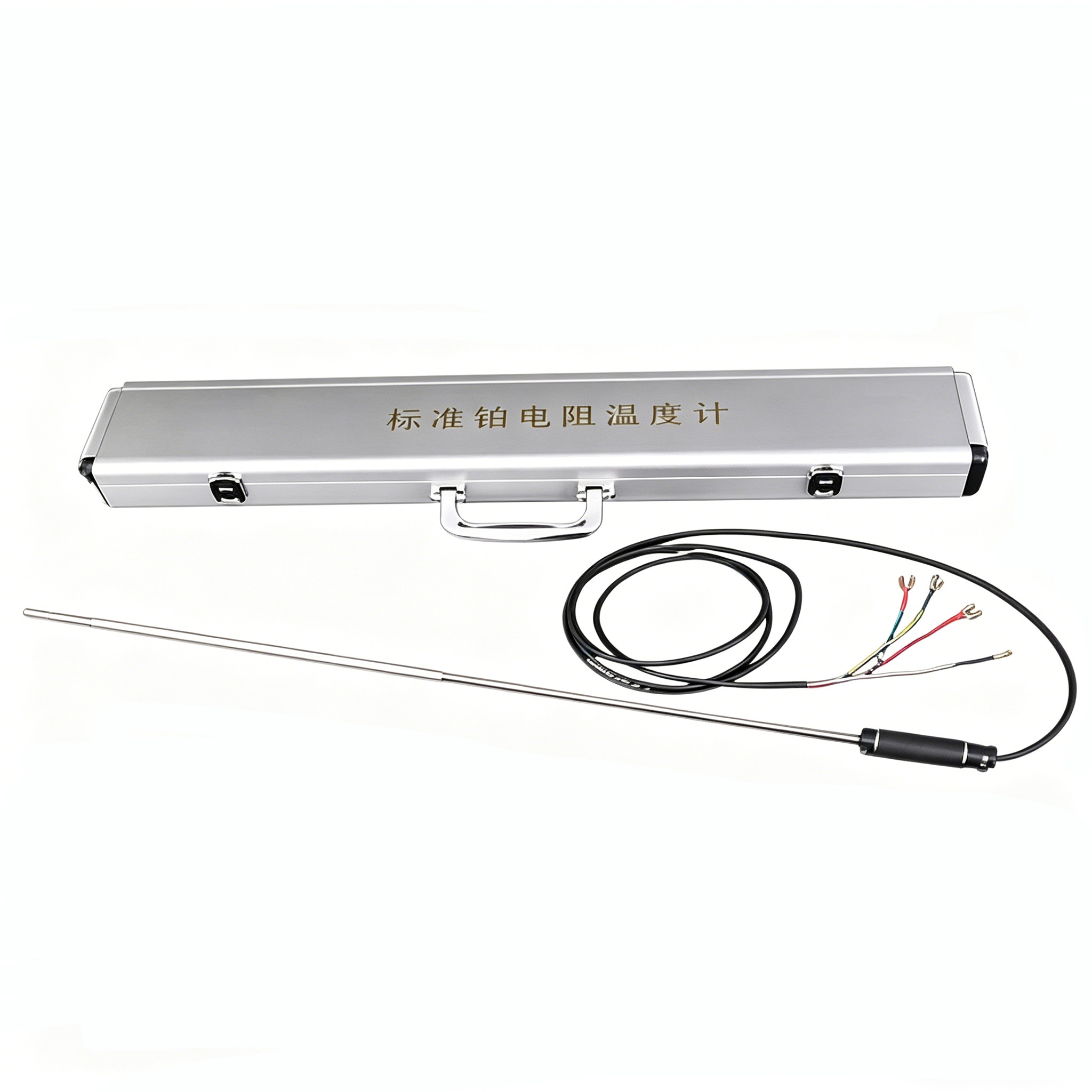
YUNYI Second-Class Standard Platinum Resistance Thermometer
The WZPB-2 Standard Platinum Resistance Thermometer (SPRT), manufactured by Xi’an Yunyi, is a metrological standard instrument used for disseminating the International Temperature Scale (ITS-90). It serves as a reference standard for verifying various types of thermometers, including standard mercury thermometers, industrial platinum resistance thermometers, industrial copper resistance thermometers, and precision thermometers. It can also be used directly for temperature measurements requiring high accuracy.
The “Zinc Point” designation indicates that this SPRT is calibrated at the fixed point of zinc (419.527°C), ensuring reliable traceability to national standards. The quartz sheath construction provides excellent insulation resistance and chemical stability at elevated temperatures.
Intended Use & Applications
Primary Function:
-
Metrological standard for transferring the International Temperature Scale (ITS-90)
-
Reference standard for thermometer verification and calibration
Specific Applications:
| Application Area | Details |
|---|---|
| Verification of standard mercury thermometers | As a reference standard |
| Verification of industrial platinum resistance thermometers (PRTs) | As a reference standard |
| Verification of industrial copper resistance thermometers (CRTs) | As a reference standard |
| Verification of precision thermometers | As a reference standard |
| Direct high-accuracy temperature measurement | For applications with stringent accuracy requirements |
| Calibration laboratories | Secondary or working standard for routine calibrations |
| Research & development | Precise temperature measurement in experiments |
| Industrial quality control | Where high-accuracy temperature data is required |
Technical Specifications
| Parameter | Specification |
|---|---|
| Model | WZPB-2 |
| Type | Second-Class Standard Platinum Resistance Thermometer |
| Fixed Point | Zinc point (419.527°C) – quartz sheath construction |
| Sheath Material | Quartz (high-purity silica) |
| Temperature Range | [ ] °C (e.g., -200 ~ +420°C or similar – please confirm) |
| Resistance at 0°C (R₀) | [ ] Ω (typically 25Ω or 100Ω for standard SPRTs) |
| Temperature Coefficient (α) | [ ] (typically ≈ 0.003925 Ω/Ω/°C) |
| Accuracy Class | Grade II (Second-Class Standard) – meets national metrological requirements |
| Long-term Stability | [ ] °C per year (typically ≤ 0.01°C) |
| Insulation Resistance | ≥ [ ] MΩ (at room temperature) |
| Current | [ ] mA (typically 1 mA to minimize self-heating) |
| Sheath Outer Diameter | [ ] mm |
| Sheath Length | [ ] mm |
| Overall Length (including handle) | [ ] mm |
| Connection Type | [ ] (e.g., 4-wire connection with dedicated connector or bare wire ends) |
Important: The above table contains placeholders
[ ]because the original product webpage did not list numerical values. Please consult Xi’an Yunyi directly or refer to the product datasheet for the exact specifications of the WZPB-2 model.
Construction & Design Features
1. Platinum Sensing Element
-
High-purity platinum wire wound in a strain-free configuration
-
Provides excellent stability and reproducibility
-
Meets the purity requirements of ITS-90
2. Quartz Sheath
-
High-purity quartz (silica) material
-
Excellent electrical insulation properties at high temperatures
-
Chemically inert and resistant to thermal shock
-
Allows clear visual inspection of the internal element
3. Four-Wire Connection
-
Eliminates lead resistance errors
-
Enables high-accuracy resistance measurement
-
Standard configuration for precision thermometry
4. Construction Quality
-
Robust mechanical design for laboratory use
-
Suitable for immersion in various calibration baths (water, oil, salt, or sand)
-
Designed for long-term stability under proper use conditions
Applicable Standards & Regulations
This SPRT complies with the relevant national and international standards for standard platinum resistance thermometers, including:
-
ITS-90 – International Temperature Scale of 1990
-
IEC 60751 – Industrial platinum resistance thermometers and sensors (reference for characteristics)
-
JJG 160 – Chinese national verification regulation for standard platinum resistance thermometers
The thermometer is suitable for use as a Grade II standard in secondary calibration laboratories.
Included in Standard Delivery
-
WZPB-2 Standard Platinum Resistance Thermometer (quartz sheath)
-
Factory calibration certificate (typically with fixed-point calibration data)
-
Protective storage case
-
Instruction manual (Chinese / English available upon request)
Optional accessories (sold separately):
-
Calibration certificate with accredited traceability (third-party)
-
Extension leads or connectors
-
Annealing furnace for periodic maintenance (if required)
Operation & Care Guidelines
Before Use:
-
Inspect the quartz sheath for cracks, chips, or contamination.
-
Check insulation resistance if a megger is available (should be >100 MΩ at room temperature).
-
Ensure proper immersion depth – typically at least 15-20 times the sheath diameter to minimize stem conduction errors.
-
Connect correctly using 4-wire configuration to avoid lead resistance errors.
During Use:
-
Handle with care – quartz is fragile and can break if dropped or struck.
-
Avoid thermal shock – do not move the thermometer directly from a hot furnace to a cold bath. Allow gradual temperature changes.
-
Use appropriate protection tubes if the environment is chemically aggressive or physically harsh.
-
Do not exceed the maximum rated temperature – excessive heat can permanently shift the resistance characteristics.
-
Use the specified measurement current (typically 1 mA) to minimize self-heating errors.
After Use:
-
Clean the sheath with a soft, lint-free cloth. For stubborn residues, use a mild solvent suitable for quartz.
-
Store in the protective case in a clean, dry, vibration-free environment.
-
Avoid contact with hard surfaces – even minor scratches can affect performance.
Periodic Maintenance:
-
Annual verification against fixed-point cells (zinc, tin, water triple point) to confirm stability.
-
Annealing may be required after exposure to high temperatures – consult the manual.
-
Recalibration by an accredited laboratory every 1-2 years depending on usage frequency.