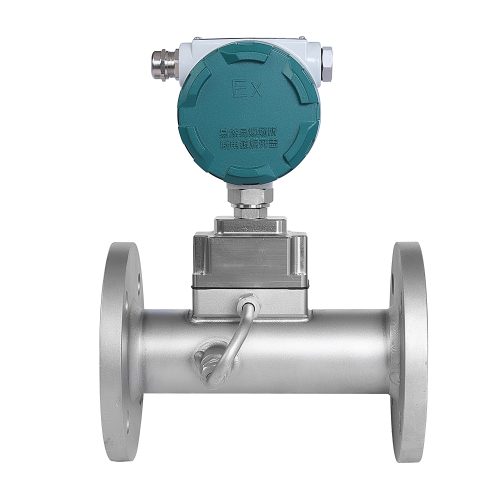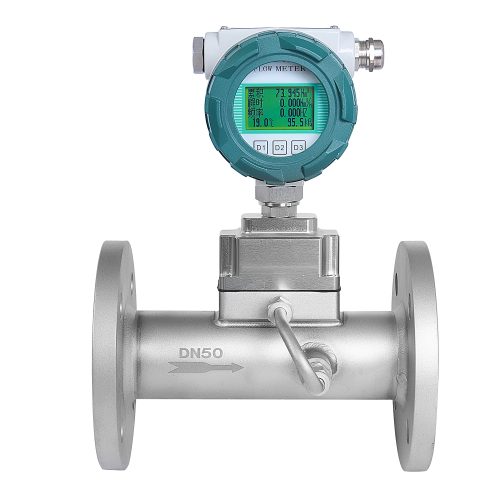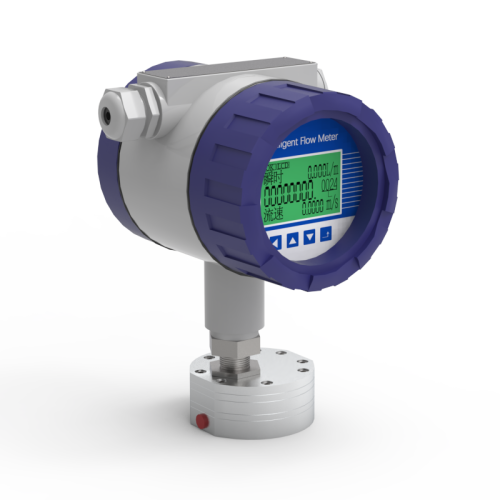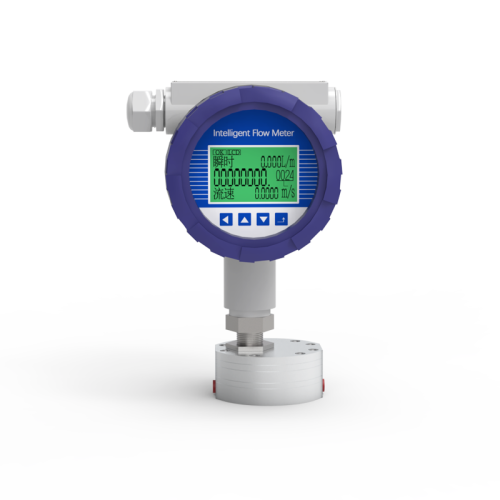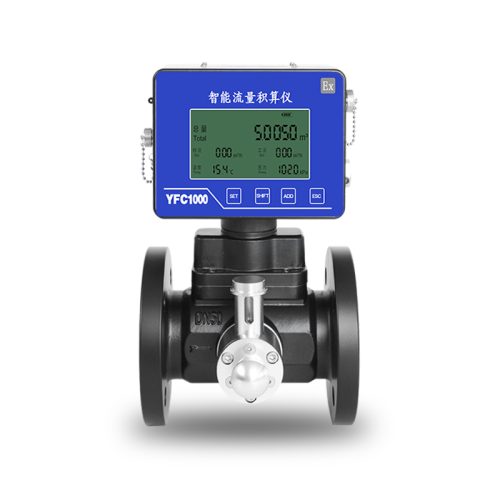


YUNYI intelligent turbine flow meter
Precision Measurement, Fine Flow · Driving Efficiency — The Expert in Low-Viscosity Liquid Metering
YUNYI liquid turbine flowmeter is a velocity-type precision flow measurement instrument. When low-viscosity liquids flow through the meter, the fluid’s kinetic energy drives the built-in precision turbine rotor to rotate. Its rotational speed is directly proportional to the fluid’s average flow velocity (i.e., volumetric flow rate). High-sensitivity non-contact magnetic or inductive sensors detect the rotational speed, converting it into a frequency signal output. This enables precise calculation of both instantaneous and cumulative liquid flow rates. With its high accuracy, excellent repeatability, superior response speed, and strong resistance to interference, it has become a widely recognized choice for applications such as trade settlement, cost control, and process monitoring.

Product Advantages
The core value of liquid turbine flowmeters lies in their exceptional accuracy, rapid response, and cost-effectiveness for measuring low-viscosity media.
1. High-Precision Measurement: Accuracy classes as high as ±0.5% R or even ±0.2% R make them ideal for trade transactions involving liquids—especially low-viscosity liquids—ensuring fair trade and minimizing measurement disputes.
2. Wide Turndown Ratio: A broad turndown ratio, typically ranging from 1:10 to 1:20, maintains accuracy across a wide flow range, effectively meeting measurement demands under varying flow conditions.
3. Exceptional Repeatability: Minimal repeatability error (typically better than ±0.1%) ensures excellent consistency in multiple measurements under identical conditions, delivering reliable and credible data.
4. Rapid Response: Responds swiftly to flow changes, effectively tracking dynamic flow variations. Ideal for process control and batching applications requiring fast response times.
5. Stable Output Signal with Strong Interference Resistance: Generates a frequency pulse signal with robust interference resistance. The signal facilitates remote transmission and is suitable for total volume measurement and quantitative control, featuring simple and convenient connectivity.
6. Compact, lightweight, and cost-effective: Features a compact structure with relatively small dimensions and light weight. While ensuring high accuracy, it offers significant advantages in procurement and installation costs, delivering a high return on investment.
Core Application Areas
✅ Petrochemical Industry: Trade transfer and distribution metering for light petroleum products (gasoline, diesel, kerosene), liquefied petroleum gas (LPG) metering.
✅ Food and Beverage Industry: Sanitary-grade quantitative filling and cost accounting for water, alcoholic beverages, soft drinks, milk, edible oils, etc.
✅ Fine Chemicals and Pharmaceuticals: Precise measurement and batch processing control for expensive media like solvents, additives, and pharmaceutical solutions.
✅ Water Treatment and Irrigation: Flow monitoring and trade settlement for raw and treated water; efficient agricultural irrigation water metering.
✅ Research and Laboratories: Serves as a standard meter for calibrating other liquid flow meters or for precision experimental apparatus.
| Oil & Chemical | Refined products (gasoline, diesel, jet fuel) transfer and loading, chemical feedstocks, solvents, additives – precise metering | 1. Custody transfer accuracy – typically ±0.2% to ±0.5%, meeting the high accuracy requirements for petroleum product transfer and chemical batching. 2. High pressure capability – can withstand system pressures up to 10 MPa or higher, suitable for pipeline transmission and tank farm loading/unloading. 3. Explosion‑proof options – available with flameproof or intrinsically safe electronics for hazardous areas with flammable liquids. |
| Water Supply & Municipal | Raw water and finished water metering at water plants, pump station transmission, industrial water distribution, large‑user water metering | 1. Low pressure drop – compared to positive‑displacement meters, turbine meters have lower pressure loss, making them suitable for gravity flow or low‑pressure water systems. 2. Large sizes available – available in DN50 to DN300 and larger, covering common municipal pipeline sizes. 3. Pulse output – facilitates integration with SCADA systems for remote monitoring and data acquisition. |
| Industrial Cooling & Heat Exchange | Plant circulating cooling water, chilled water, hot water, flow measurement for heat exchange stations | 1. Fast response – reacts quickly to flow changes, ideal for cooling systems with frequent load variations. 2. Wide temperature range – covers media temperatures from -40 °C to +150 °C, suitable for different cooling media and process conditions. 3. Good long‑term stability – simple construction provides long maintenance intervals in clean water applications. |
| Food & Beverage | Purified water, fruit juice, beer, milk, beverage blending water, CIP cleaning fluids | 1. Hygienic design – available in stainless steel with tri‑clamp connections, smooth surfaces with no dead zones, meeting food‑grade requirements. 2. Easy to clean – some models support clean‑in‑place (CIP), suitable for food and beverage operations with frequent product changes. 3. High‑accuracy batching – used for formula beverages, flavored liquids, and other applications requiring precise ratio control. |
| Machine Integration & Testing | Hydraulic test stands, engine fuel consumption testing, cooling system testing, flow calibration facilities, liquid dispensing equipment | 1. High repeatability – repeatability typically better than ±0.1%, making them ideal for test stands, calibration rigs, and other applications demanding consistency. 2. High‑frequency pulse output – high‑resolution pulse signals meet the requirements for fast instantaneous flow response and precise totalization control. 3. Compact design – small footprint and light weight, easy to integrate into equipment and test apparatus. |
Q1: What is a Liquid Turbine Flow Meter and how does it work?
A: A Liquid Turbine Flow Meter is a high-precision, velocity-sensing instrument designed for measuring the volumetric flow rate of clean, low-viscosity liquids. At its core is a multi-bladed rotor (turbine wheel) mounted on bearings within the flow stream. The kinetic energy of the flowing liquid causes the rotor to spin at a speed directly proportional to the flow velocity. A magnetic or inductive pickup coil outside the flow body detects each passing blade tip, generating a high-frequency electronic pulse signal. The pulse rate corresponds to the flow rate, while the total pulse count provides the total volume passed.
Q2: What are the key advantages of choosing a Liquid Turbine Meter?
A:
✅ High Accuracy & Repeatability: Delivers excellent accuracy, typically within ±0.5% to ±1% of reading over a calibrated range, with superb repeatability. Ideal for precise process control, batching, and custody transfer.
✅ Excellent for High-Speed, High-Flow Applications: Excels in measuring rapid, high-volume flows common in water distribution, fuel transfer, and industrial processes.
✅ Wide Turndown Ratio: Offers a broad operational flow range (e.g., 6:1 to 10:1 or higher), accommodating variable process demands with a single meter.
✅ Fast Dynamic Response: Reacts almost instantly to changes in flow rate, perfect for fast-loop control and rapid filling operations.
✅ Wide Range of Sizes & Materials: Available from small bore (DN4) to large line sizes (DN250+), with wetted parts in stainless steel, Hastelloy, or plastics for diverse fluid compatibility.
Q3: Which industries and liquid applications is it best suited for?
A:
-
Primary Industries: Chemical & Petrochemical, Oil & Gas (fuel loading, crude transfer), Water & Wastewater, Pharmaceutical, Food & Beverage, Aerospace (fuel testing), and Power Generation.
-
Ideal Applications & Media:
-
Clean, low-viscosity liquids (Water, demineralized water, solvents, light fuels, alcohols).
-
Cryogenic liquids (LNG, liquid nitrogen, LPG).
-
Chemical process streams.
-
High-purity or sanitary liquids in Food & Pharma (with 3-A compliant designs).
⚠️ Critical Limitation: Unsuitable for viscous, dirty, or abrasive fluids. Particles can damage bearings and blades, while high viscosity (>10-15 cSt) severely degrades accuracy and range. An upstream filter is almost always mandatory.
-
Q4: How does it compare to other common liquid flow meters?
A:
| Aspect | Liquid Turbine Meter | Positive Displacement (Oval Gear) | Electromagnetic Flow Meter |
|---|---|---|---|
| Principle | Velocity (turbine rotation). | Volumetric (fixed cavity displacement). | Faraday’s Law (electromagnetic induction). |
| Best For | Clean, low-viscosity, high-speed flows. | High-viscosity, lubricating, or clean liquids. | Conductive liquids only, including slurries and dirty fluids. |
| Moving Parts | Yes (turbine rotor on bearings). | Yes (meshing gears/rotors). | No. |
| Pressure Drop | Low to moderate (depends on design). | Higher, increases with viscosity. | Negligible (no obstruction). |
| Viscosity Impact | Severe degradation at higher viscosity. | Unaffected or improved performance. | None (measures conductive phase velocity). |
| Key Strength | Cost-effective precision for clean, fast flows. | High accuracy with viscous fluids. | Handles dirty/abrasive fluids, no pressure loss. |
Q5: What is the “K-factor” and why is it crucial?
A:
-
K-factor (Meter Coefficient): This is the meter’s unique calibration constant, expressed as pulses per unit volume (e.g., pulses/gallon or pulses/liter). It is determined by flow calibration under specific conditions. Total volume = Total Pulses / K-factor.
-
Linearity & Calibration: The K-factor is not always perfectly constant across the entire flow range. High-quality meters provide a linearity curve or a multi-point K-factor table from the factory. For highest accuracy, calibration should match the process fluid’s viscosity and density as closely as possible.
Q6: What are the essential factors for selection and proper installation?
A:
Selection Checklist:
-
Fluid Properties: Viscosity (most critical – must be low), density, temperature, cleanliness, and corrosiveness.
-
Flow Range: Define minimum, normal, and maximum flow rates. Ensure the meter’s specified range covers your needs, staying above the low-flow cut-off for accuracy.
-
Process Conditions: Operating pressure and temperature ratings.
-
Material Compatibility: Choose body and rotor materials (SS304, SS316, PTFE seals, etc.) compatible with the fluid.
-
Accuracy & Output: Required accuracy class and output signal (pulse, 4-20mA, or digital protocols like Modbus).
Critical Installation Best Practices:
-
Filtration: Always install a suitable upstream filter (e.g., 100 mesh) to protect the turbine.
-
Flow Conditioning: Ensure a fully developed, swirl-free profile. Use 10-15 diameters of straight pipe upstream and 5 diameters downstream. A flow conditioner may be needed near pumps or elbows.
-
Orientation: Typically installed horizontally. If vertical, flow should be upward to keep the rotor buoyant and bearings lubricated.
-
Avoid Cavitation: Ensure sufficient backpressure to prevent liquid from flashing into vapor, which can destroy the rotor.
Q7: What about maintenance, longevity, and system integration?
A:
-
Primary Wear Parts: Rotor bearings are the main wear component. Lifespan depends entirely on fluid cleanliness, lubrication properties, and operating speed.
-
Maintenance: Primarily involves regular filter cleaning/replacement and monitoring for changes in meter factor or increased noise/vibration, indicating wear or damage.
-
System Integration: Easily integrates into control systems. Pulse outputs connect to batch controllers or PLCs. 4-20mA or digital outputs (HART, Modbus) enable direct SCADA/DCS integration for monitoring and control.
-
Calibration Interval: Recalibration is recommended every 1-3 years for critical applications, depending on service conditions.
Q8: Are there specific standards and certifications for these meters?
A: Yes, applicable standards ensure performance and safety:
-
Accuracy Standards: ISO 4064 (water), API Chapter 5.3 (hydrocarbons), OIML R117.
-
Hygienic/Sanitary: 3-A Sanitary Standard, EHEDG, FDA-compliant materials for food/pharma.
-
Safety & Compliance: ATEX/IECEx (explosive atmospheres), CRN/PED (pressure equipment), NSF (potable water).